

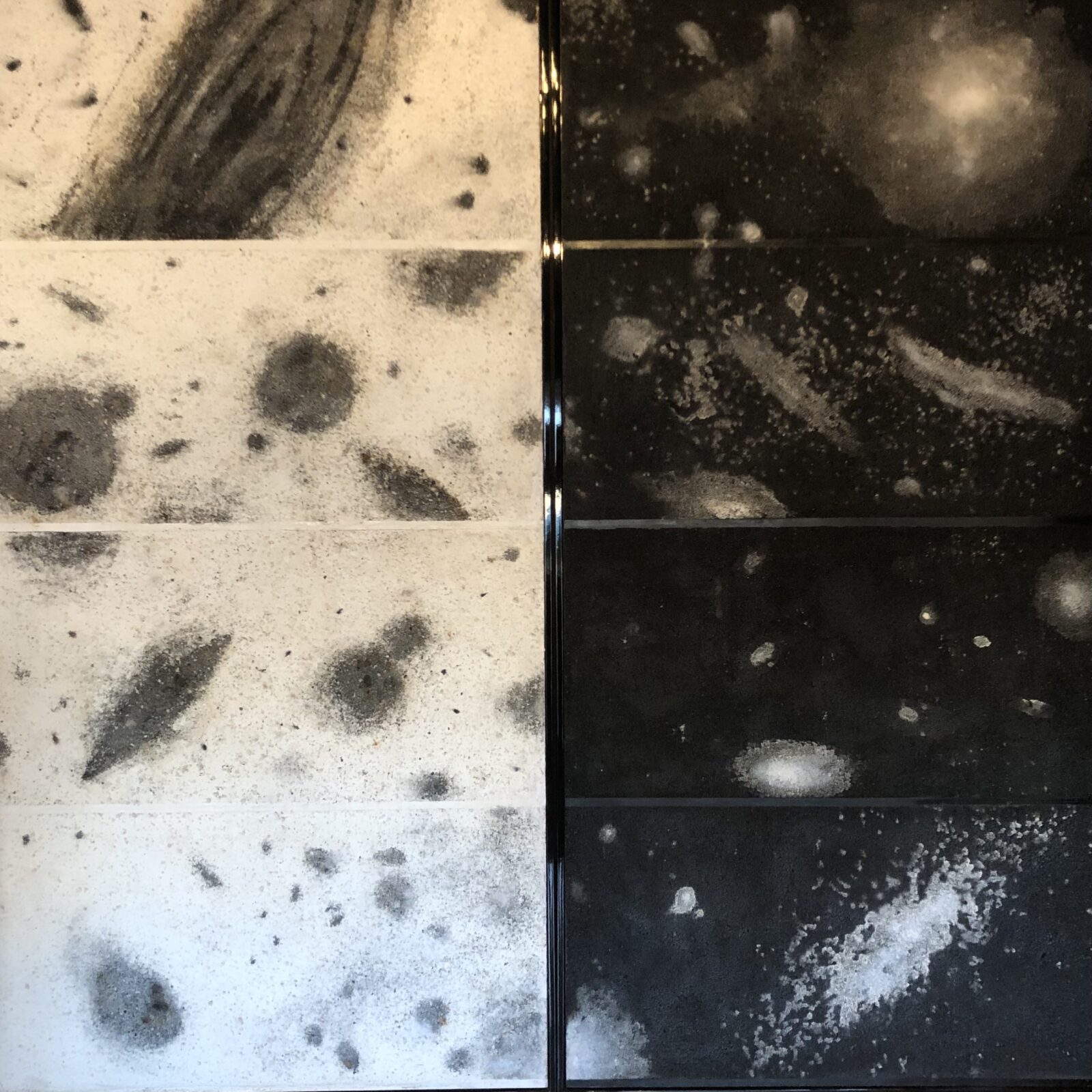
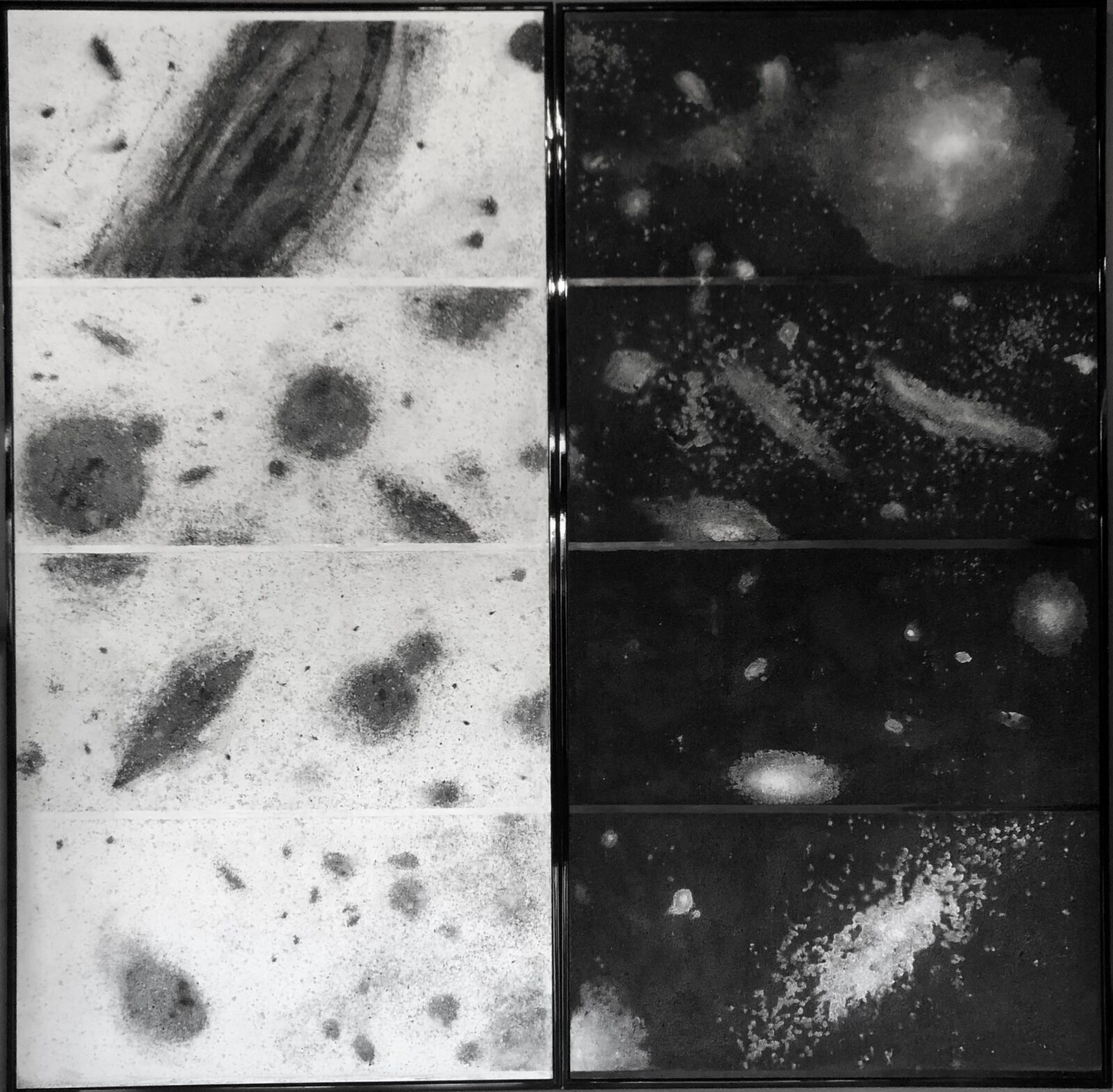
Galactic Stratigraphy, 2009
Karel Nel, (SA 1955-)
Black carboniferous dust & salt on wooden folding screen.
Signed & titled on reverse
240 x 240 cm
Provenance : Exhibited & sold at Circa Gallery’s inaugural exhibition in 2009. Private collection Johannesburg.
Reference : illustrated in exhibition catalogue (text below)
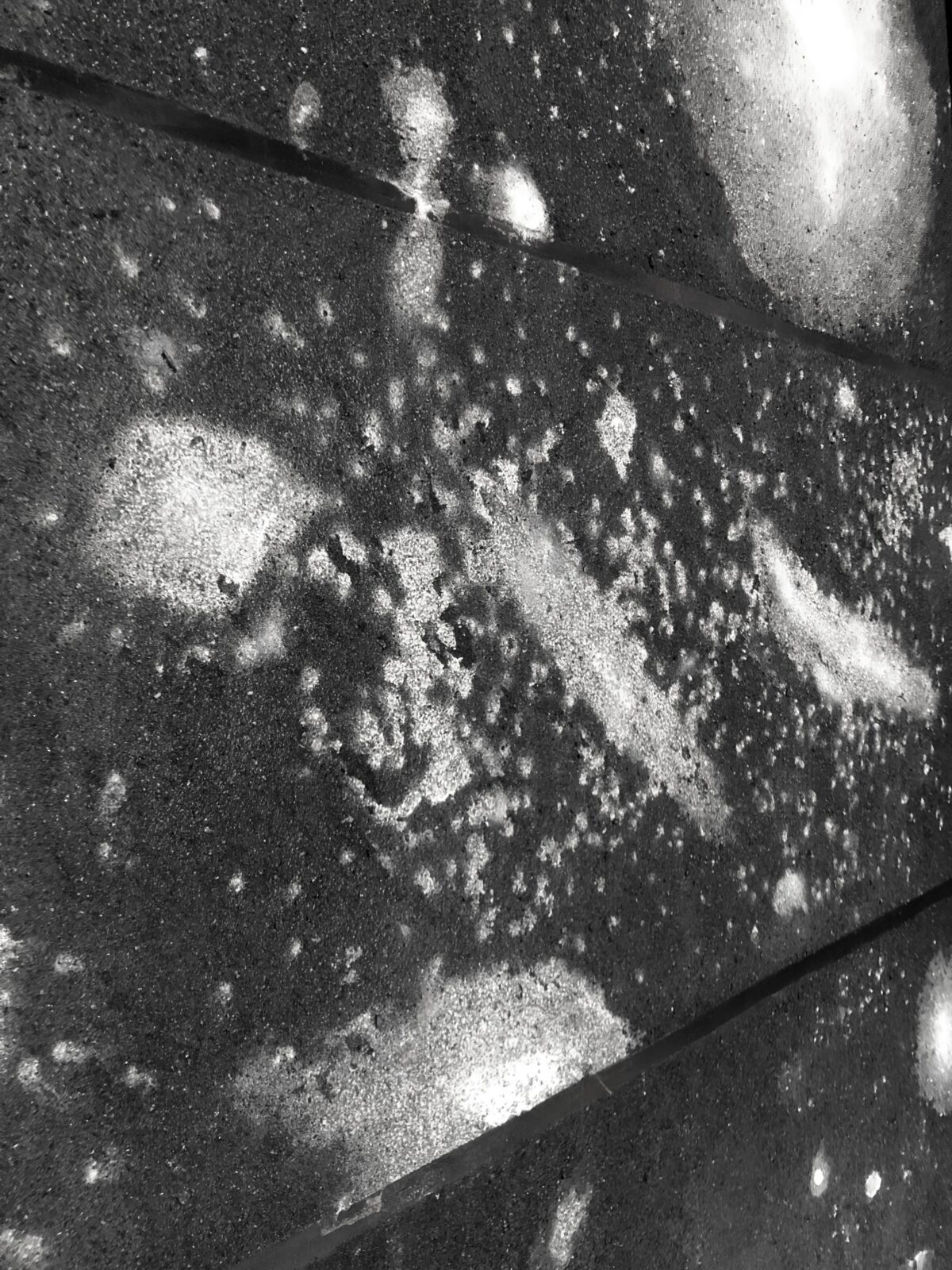
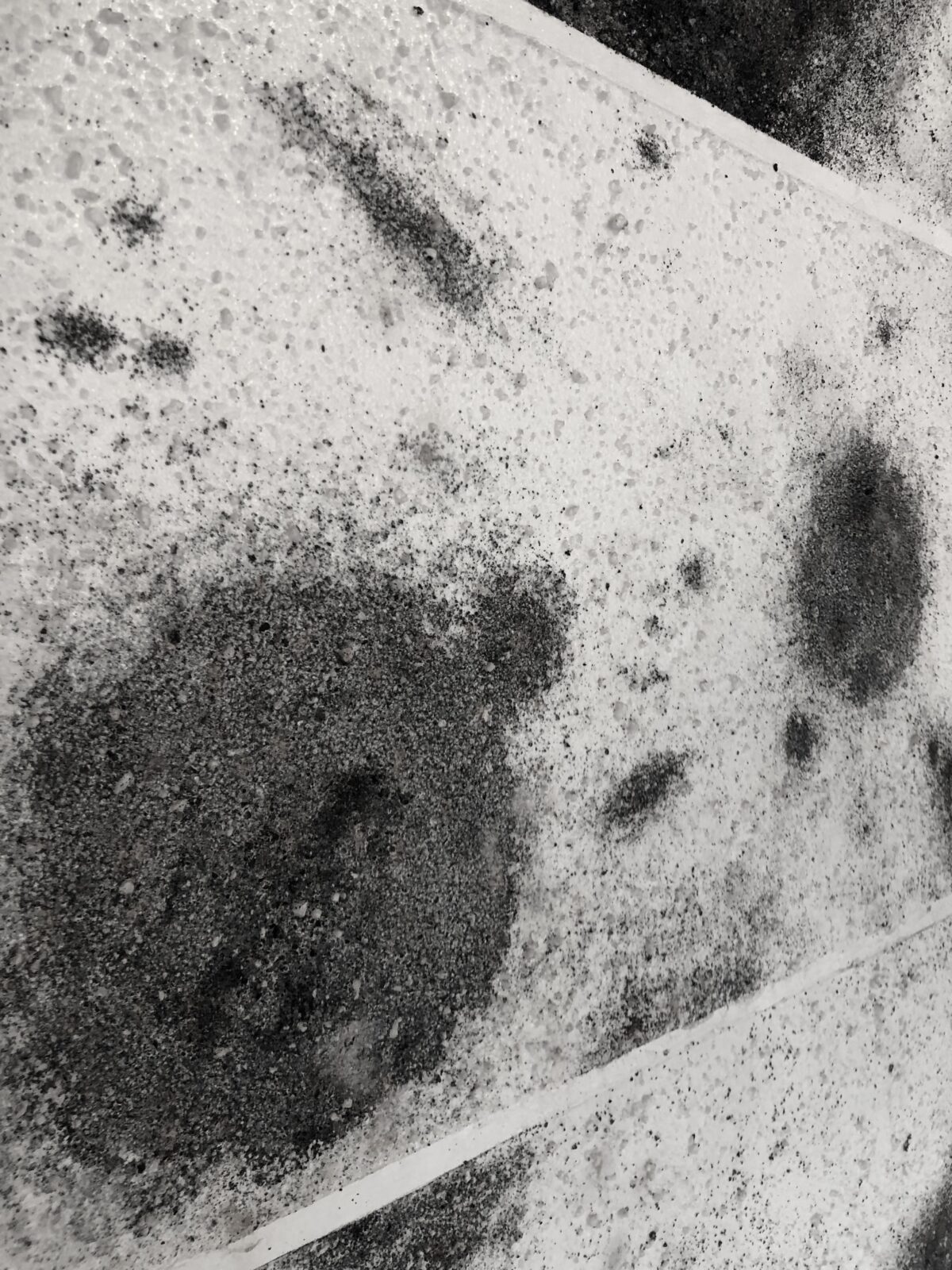
The pivotal point of the screen is the seam between lightness and darkness, the two extremes of the astronomical field. The left-hand panel, in its sheer crystalline lightness, refers to the capture of galactic imagery in the reverse, that is, the dark sky transposed to lightness, enabling clearer analysis of the data. The right-hand panel, with its gleaming darkness of dense carboniferous dust, captures the ghostly traces of distant galaxies and faint emanations. The disjuncture down the central seam of the work is, in Leon de Kock’s words, “the place where difference and sameness are hitched together – where they are brought to self-awareness, denied, or displaced into third terms: a place of simultaneous convergence and divergence, the seam is the paradox qualifying any attempt to imagine organicism or unity” (in Nuttall,2009:5). Seams, where phenomena abut, are the sites of the simultaneous recognition of both.
This counterpoint of lightness and darkness structures the image vertically, while the horizontal banding alludes to the ordered stacking of galactic imagery into a ruled and text-like format, which is further amplified by the folded screen structure, standing evocatively like an open book. This form alludes to a mode of literacy – of reading and comprehension – but inevitably remains opaque.
As an artist I find myself constantly attempting to come to terms with the extremes and opacities of astrophysics. It is in many ways powerfully impersonal and disembodied; yet it focuses consciousness in its attempt to grasp our place in the series of complex events that have formed our universe.
Galactic Stratigraphy, with its use of 540-million-year-old carboniferous dust from Gondwanaland, and the brilliance of the white salt from the Earth’s oceans, represents stripped, snatched images of deep space and its galaxy populations. They are fragmented sequences that abut each other and define each other, yet remain partial in a staccato-like aesthetic. One is prompted to look backwards and forwards simultaneously. The images are stacked to form a stratigraphy of galactic information, reflecting thé human need to order information in a layered and chronological sequence, in some ways replicating the geological process of sediment upon sediment that creates a natural stratigraphy. As we comprehend our world as composed of matter from violent events such as star emissions and from convulsive geological episodes that have created complex stratigraphies, cosmic time is dramatically dilated in relation to evolution, to Darwin, palaeoanthropology and the structure of DNA. It is therefore difficult not to be deflated by the immensity of the universe and its phenomena which remain difficult to grasp, integrate, encode and represent in a communicable way.
()
| Dimensions | 240 × 240 cm |
|---|---|
| origin | South Africa |